Disclosure
This website contains affiliate links. When you click on these links and make a purchase, I might earn a commission at no extra cost.
The content I provide here isn’t financial advice and shouldn’t be considered as such. Please consult your financial advisor before making any investment decision.
Also, remember that every investment carries its own risks and disadvantages. Lastly, past results do not guarantee future returns.
The content I provide here isn’t financial advice and shouldn’t be considered as such. Please consult your financial advisor before making any investment decision.
Also, remember that every investment carries its own risks and disadvantages. Lastly, past results do not guarantee future returns.
Fiat Money Explained
FIAT MONEY
Fiat money is a currency not backed by a precious metal, such as gold or silver, or any other tangible asset or commodity.
Fiat currency is typically designated by the issuing government as legal tender and authorized by government regulation.
NO INTRINSIC VALUE
Fiat money generally lacks intrinsic value and does not possess use value. Its worth is only determined by the agreement of individuals who use it as a unit of account—or, in the case of currency, as a medium of exchange.
They trust that merchants and others will accept it as a means of payment for liabilities.
INFLATION
One of the most well-known disadvantages of fiat money is the risk of inflation. Since any valuable commodity doesn’t back fiat currency, it can be printed in unlimited amounts, especially if a government faces budget deficits or high debt levels. This can result in a vicious cycle of debt and inflation, which may lead to economic bubbles.
Fiat money is a currency not backed by a precious metal, such as gold or silver, or any other tangible asset or commodity.
Fiat currency is typically designated by the issuing government as legal tender and authorized by government regulation.
NO INTRINSIC VALUE
Fiat money generally lacks intrinsic value and does not possess use value. Its worth is only determined by the agreement of individuals who use it as a unit of account—or, in the case of currency, as a medium of exchange.
They trust that merchants and others will accept it as a means of payment for liabilities.
INFLATION
One of the most well-known disadvantages of fiat money is the risk of inflation. Since any valuable commodity doesn’t back fiat currency, it can be printed in unlimited amounts, especially if a government faces budget deficits or high debt levels. This can result in a vicious cycle of debt and inflation, which may lead to economic bubbles.
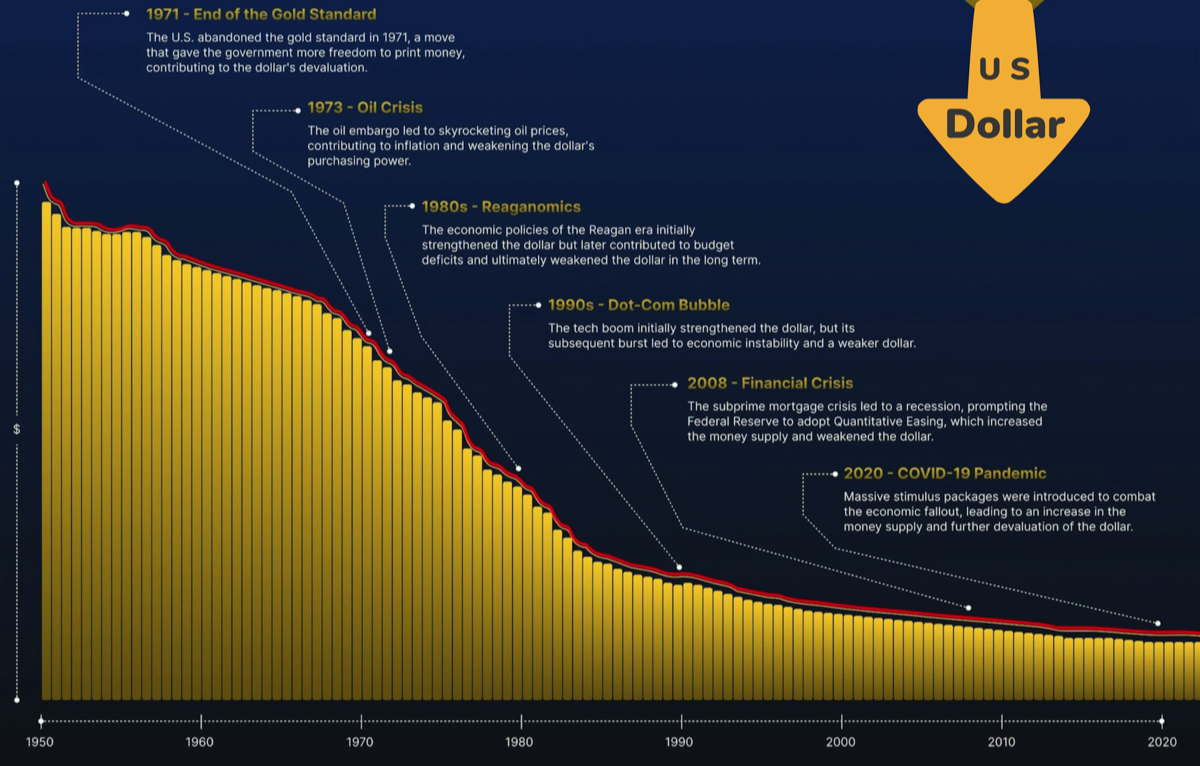
US Dollar Since It Became Fiat Money